Yom Kippur—Before the Mercy Seat
11 × 14 Photographic Print — $29.99
The print is professionally produced on premium photographic paper, capturing the vibrant colors and intricate details of the original artwork. Shipping available within the United States only.
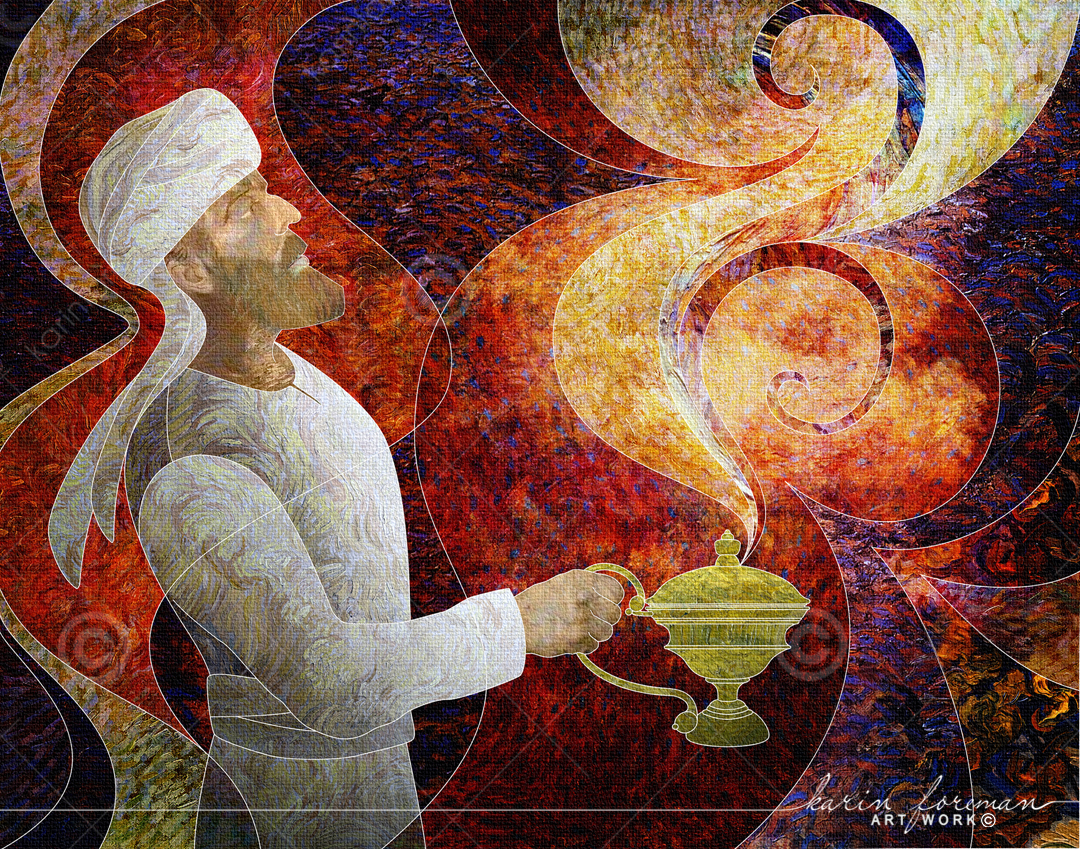
Before the Mercy Seat portrays the Kohen Gadol, the Jewish High Priest, entering the Holy of Holies on Yom Kippur, the Day of Atonement, carrying the sacred incense. On this holiest day of the biblical year, the High Priest alone was permitted to enter the innermost sanctuary of the Temple, approaching the place associated with the Divine Presence.
The golden incense vessel held before him represents the ketoret, the sacred incense offered before God. As the incense burned, its fragrant smoke rose and filled the Holy of Holies, covering the Kapporet, the cover of the Ark of the Covenant, often called the Mercy Seat. Leviticus describes the smoke as covering the place above the Ark so that the High Priest would not die when entering into the Divine Presence. In this sense, the cloud of incense serves as a sacred veil, shielding the human being from directly looking upon the overwhelming holiness of God.
The artwork captures that profound tension between human vulnerability and Divine holiness. The High Priest’s upward gaze suggests reverence, humility, and awe rather than an attempt to look directly upon God. The swirling clouds of incense become almost architectural, creating a luminous veil between the earthly priest and the unseen Divine Presence. The sweeping curves suggest the movement of prayer ascending toward heaven, while the spiraling forms evoke mystery, eternity, and the unseen spiritual realm.
The golden vessel is especially significant. Gold recalls the sacred furnishings of the Temple and the holiness of the Ark, while its luminous presence draws the eye toward the center of the spiritual encounter. The brilliant gold, amber, red, and deep blue tones create an atmosphere of fire, majesty, sacrifice, and divine mystery. The darker areas surrounding the figure emphasize that the Holy of Holies was not merely a physical room, but a threshold between the visible world and the hidden presence of God.
At the heart of the Yom Kippur observance is atonement, repentance, purification, and reconciliation. The High Priest’s entrance represents the sacred responsibility of approaching God on behalf of the people. The incense, rising smoke, and concealed Divine Presence together express the ancient Jewish understanding that God is profoundly near, yet also beyond human sight and comprehension.
Artistic Form
The artwork combines figurative realism with abstraction and painterly mixed media techniques. The recognizable figure of the Kohen Gadol is rendered with a softly realistic quality, while the surrounding environment dissolves into expressive layers of color, texture, sweeping lines, and spiraling forms. The highly textured surface resembles oil painting and oil pastel, with visible strokes and richly layered pigment creating a tactile, almost woven appearance.
Fine, luminous linework flows throughout the composition, connecting the figure, incense, and surrounding forms. These lines give the smoke an almost spiritual life of its own, transforming it from ordinary vapor into a visual representation of prayer, holiness, and the mysterious boundary between humanity and God.
The result is not a literal but a symbolic interpretation of the High Priest’s most sacred Yom Kippur journey: approaching the Holy of Holies, surrounded by incense, standing at the threshold of the Divine Presence, yet protected by the sacred cloud from seeing what no human being could behold directly.