Yom Kippur—Ne’ilah
11 × 14 Photographic Print — $29.99
The print is professionally produced on premium photographic paper, capturing the vibrant colors and intricate details of the original artwork. Shipping available within the United States only.
Artwork Description
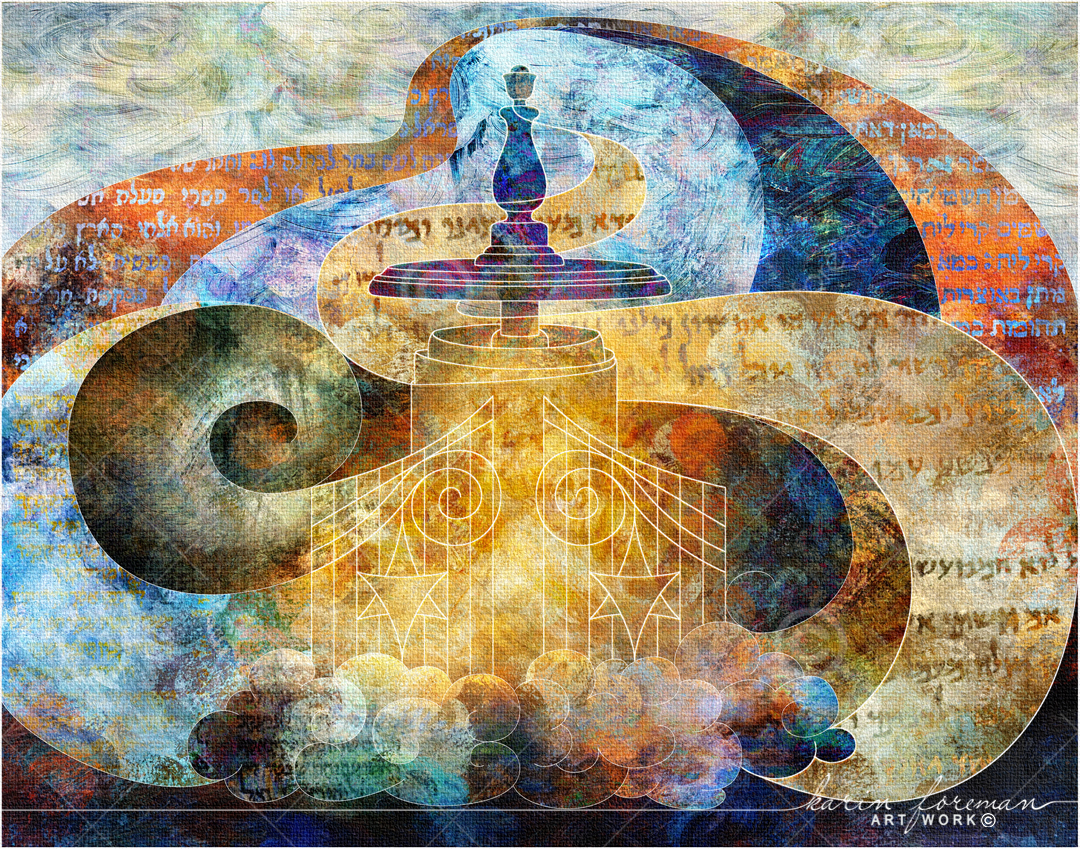
This contemporary Jewish mixed media painting captures the profound spiritual intensity of Yom Kippur, particularly the final moments of Ne’ilah, the concluding service known as the “Closing of the Gates.” The composition is built around a monumental central Torah, rising within an architectural form that suggests both the Gates of Heaven and a passage between the earthly world and Olam HaBa, the World to Come. Sweeping arcs and spiraling forms curve inward around the Torah, creating a powerful sense that the gates are gradually closing while a luminous spiritual realm remains visible beyond them.
Throughout the painting, fragments of Hebrew prayer are woven into the painted surfaces, allowing the artwork itself to function almost like a visual page from a Yom Kippur machzor. In the upper left, the words זכרנו לחיים מלך חפץ בחיים… וכתבנו בספר החיים, “Remember us for life, King who desires life… and inscribe us in the Book of Life,” come from the Zochrenu L’Chaim addition to the High Holy Day Amidah. The prayer expresses the central plea of the Days of Awe: to be remembered, inscribed, and granted life.
In the upper right, כל נדרי ואסרי…, “All vows and prohibitions…,” evokes Kol Nidrei, the solemn declaration that opens the evening of Yom Kippur. Its presence establishes the beginning of the sacred day, while the surrounding imagery moves progressively toward its conclusion. The painting therefore contains a visual movement through Yom Kippur itself, from the opening prayers to the final closing of the gates.
On the right side, the fragment וחתמנו בספר…, “and seal us in the Book…,” points directly toward Ne’ilah and its intensified language of sealing. During Ne’ilah, the liturgy shifts from the language of being written toward the language of being sealed, giving the final service its extraordinary sense of urgency and finality. The sweeping forms surrounding the Torah visually reinforce this transition, appearing like enormous gates drawing toward closure.
The lower right contains language associated with the biblical affirmation כי לא אחפוץ במות המת…, “For I do not desire the death of the one who dies,” from Ezekiel 18:32, a verse closely connected with the themes of repentance and return expressed in the Unetaneh Tokef liturgy. The complete biblical verse concludes with the call to return and live, emphasizing that the Divine desire is ultimately directed toward repentance and life rather than destruction.
A further fragment appears above the central form, דא מן… ידעתי וצפיתי, carrying Aramaic and Hebrew language suggestive of knowledge, vision, and hidden spiritual realms. Because the words are intentionally fragmented within the artwork, they function less as a single continuous quotation and more as part of the layered sacred text that surrounds the central Torah. Their placement above the wood roller (Etz Chaim (עץ חיים) contributes to the painting’s visual suggestion of heavenly knowledge and the unseen realm.
The central Torah becomes the spiritual anchor of the entire composition. Its golden presence is surrounded by intricate white linear designs, including geometric and star of David forms, while the broad curved shapes around it suggest gates, pathways, and the movement between worlds.
The sense of Olam HaBa, the World to Come, is expressed not as a literal depiction of heaven, but through light, elevation, depth, and an increasingly luminous space beyond the gates. The painting holds two ideas simultaneously: the gates are closing, yet the spiritual world beyond them remains present. This creates a tension between finality and hope, judgment and mercy, earthly life and what lies beyond it.
Art Form and Medium
The work is a contemporary Jewish mixed media painting combining richly textured painterly surfaces, layered Hebrew text, translucent color fields, geometric linework, and symbolic architectural forms. The surface incorporates multiple visual layers of blues, turquoise, gold, ochre, orange, burgundy, and earth tones, creating depth and movement across the composition. Hebrew lettering is integrated directly into the painted fields rather than functioning simply as an inscription, making sacred text part of the visual structure itself.
Crisp white linear drawing defines the central Torah, ornamental details, and geometric forms, contrasting with the heavily textured and expressive painted surfaces. Large sweeping shapes create the architectural impression of monumental gates, while circular and spiral forms introduce movement and suggest spiritual passage. The combination of painterly texture, graphic linework, layered text, symbolic imagery, and contemporary abstraction gives the work a distinctive mixed media Jewish visual language, bringing traditional Yom Kippur liturgy into a contemporary artistic form.
At its heart, the painting portrays Ne’ilah as a threshold: the final prayers rise toward the closing gates, the Book of Life is invoked, and the soul stands between the world it knows and the mystery of Olam HaBa.