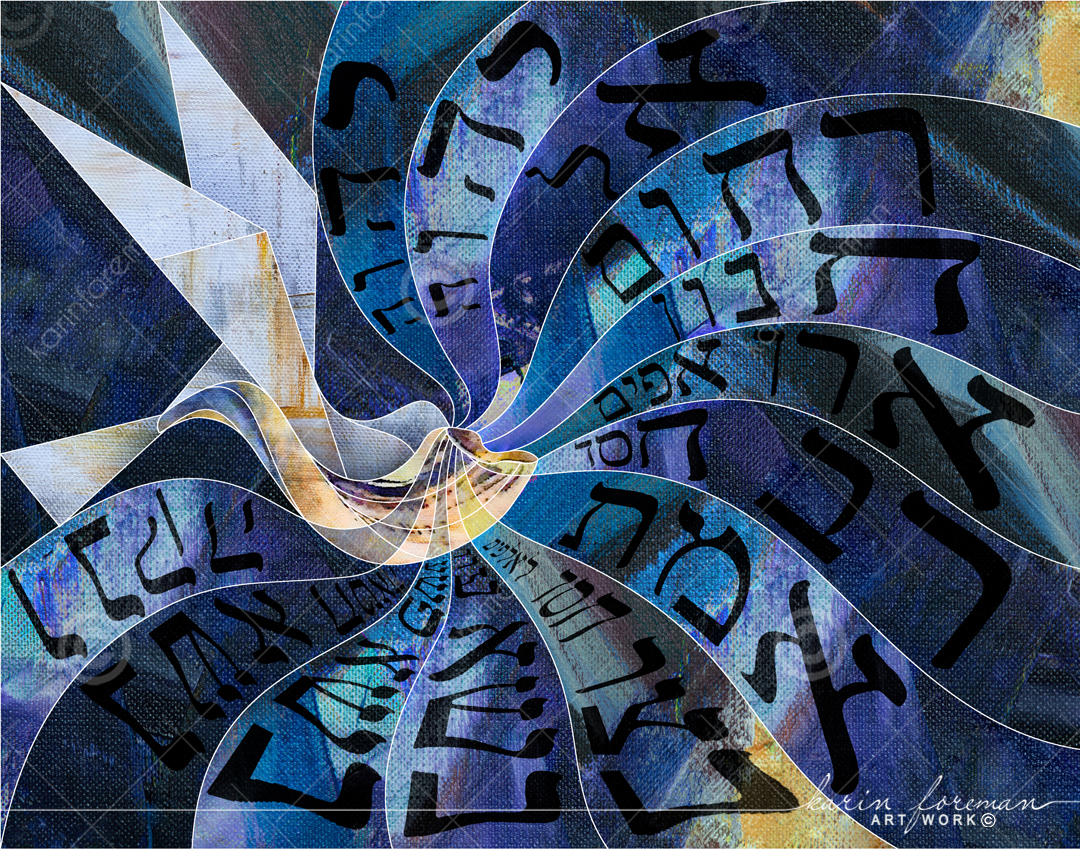
Yom Kippur—The Thirteen Attributes of Mercy
11 × 14 Photographic Print — $29.99
The print is professionally produced on premium photographic paper, capturing the vibrant colors and intricate details of the original artwork. Shipping available within the United States only.
The Thirteen Attributes of Mercyis an abstract mixed-media painting of the Thirteen Attributes of God’s Mercy (the Shelosh Esrei Middot, revealed to Moses in Exodus 34:6–7), with the shofar calling the soul to repentance and the dove symbolizing peace, reconciliation, and the hope of renewal. At the heart of the composition, sweeping ribbons of color and Hebrew letters spiral outward like streams of prayer, suggesting that divine mercy continually flows toward those who seek forgiveness and reconciliation.
The Hebrew woven throughout the artwork represents the biblical passage traditionally recited during Yom Kippur and other penitential prayers:
יְהוָה יְהוָה אֵל רַחוּם וְחַנּוּן אֶרֶךְ אַפַּיִם וְרַב חֶסֶד וֶאֱמֶת נֹצֵר חֶסֶד לָאֲלָפִים נֹשֵׂא עָוֹן וָפֶשַׁע וְחַטָּאָה וְנַקֵּה
“Adonai, Adonai, God, compassionate and gracious, slow to anger, abundant in kindness and truth, preserving kindness for thousands, forgiving iniquity, transgression, and sin, and cleansing.”
The Hebrew is deliberately integrated into the visual structure rather than presented as ordinary lines of text. Individual words and phrases can be discerned among the sweeping forms, including יהוה יהוה, אל, רחום וחנון, ארך אפים, ורב חסד ואמת, נוצר חסד לאלפים, נשא עון ופשע וחטאה, and ונקה. Their movement through the composition reflects the way these sacred words are repeatedly carried through Yom Kippur liturgy.
The 13 Attributes Breakdown
- יהוה (Adonai / Hashem)
Compassion before a person sins. God acts with mercy toward a human being even when He knows they are destined to stumble in the future. - יהוה (Adonai / Hashem)
Compassion after a person sins. God accepts the sinner with open arms if they choose path of teshuvah (repentance), rather than cutting them off permanently. - אל (El)
The Mighty God. This name denotes supreme strength and absolute power, signifying that God’s ability to show mercy overcomes even strict, rigid judgment. - רחום (Rachum)
Compassionate. God actively buffers humanity from severe distress and softens the immediate, harsh consequences of human error. - וחנון (Ve’Chanun)
And Gracious. God extends unearned favor, love, and assistance to those who are already downcast, even if they lack personal merits or good deeds to deserve it. - ארך אפים (Erech Apayim)
Slow to anger. God does not punish instantly. He is long-suffering, granting people the vital asset of time to reflect, pivot, and correct their actions. - ורב חסד (Ve’Rav Chesed)
Abundant in kindness. God tips the scales of judgment toward kindness. If an individual’s virtues and faults are perfectly equal, God pushes them toward the side of goodness. - אמת (Emet)
Truth. God is utterly faithful to His promises and never reneges on His word to ultimately reward those who try to align with righteousness. - נצר חסד לאלפים (Notzer Chesed La’alafim)
Preserver of kindness for thousands of generations. The credit of a person’s good deeds and ancestral righteousness (Zechut Avot) is securely preserved by God to protect their descendants far into the future. - נשא עון (Noseh Avon)
Forgiver of iniquity. God carries away and forgives intentional sins (avonot) that result from passion, internal desires, or lapses in self-control. - ופשע (Va’Fesha)
And transgression. God extends his mercy to forgive willful acts of rebellion (pesha’im) committed with the explicit intent to challenge authority, provided the person undergoes genuine reform. - וחטאה (Ve’Chata’ah)
And sin. God forgives accidental missteps, errors made out of carelessness, or simple human ignorance (chet). - ונקה (Ve’Nakeh)
And Who cleanses / absolves.
The artwork takes the form of abstract mystical mixed media, combining painterly textures, layered translucent forms, geometric fragmentation, and expressive Hebrew calligraphy. The ribbon-like shapes converge at a luminous central point before unfolding outward in many directions. This creates the impression of prayer rising, returning, and expanding. The center can be understood as a spiritual point of teshuvah, where confession, repentance, mercy, and renewal meet.
Deep blues, indigos, turquoise, violet, charcoal, and touches of gold create a contemplative atmosphere. The darker passages evoke the solemnity and introspection of Yom Kippur, while the luminous whites and golden areas suggest divine presence, hope, forgiveness, and the possibility of beginning again.
Rather than illustrating Yom Kippur literally, the work visualizes the experience of standing before God in repentance. The fragmented Hebrew suggests the searching heart, while the flowing forms suggest mercy moving through and beyond human brokenness. The composition ultimately becomes a visual prayer: surrounded by sacred words, the worshipper turns inward, seeks forgiveness, and emerges toward the cleansing light of a renewed relationship with God.